
J.W. Warner Talks About Fantasy Novel ‘Isle of Clouds’

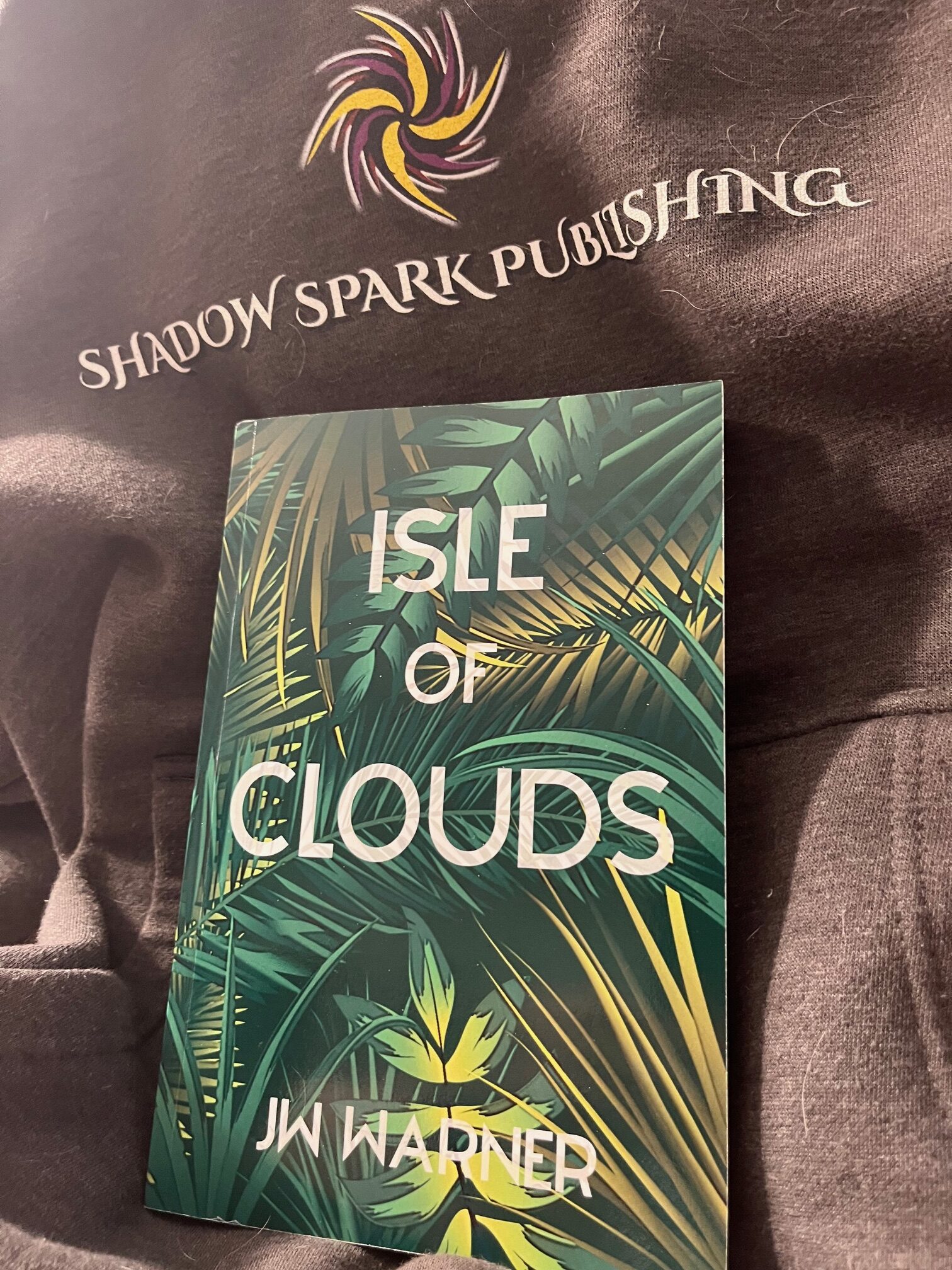
Author J.W. Warner’s Isle of Clouds is the story of Gaima and her supernatural abilities in service to her island village, earning her the title of “Holy.”
Starting with her apprentice duties to the village shaman, it becomes clear Gaima is remarkably talented, with abilities enhanced by her connections to the land of ghosts and the mysterious and powerful Forest Spirits. Soon, the other shamans defer to their younger colleague.
When strangers from across the sea seem to endanger the whole island, every village looks to Gaima to save them.
The author won the Fantasy category at the 2025 Halloween Book Festival and answered a few questions about Gaima’s story.
Q: What was the inspiration for the tribes and their adversaries in this story?
JW WARNER: I began this book with a fundamental concept: indigenous people resisting colonizers, who would use magic to repel their attackers. I also wanted to explore the dynamics of people usually divided into different cultures who must cooperate, because by remaining separate, they will probably fail in their resistance.
The invading forces are technologically ahead of the islanders, but not by such a large degree that resistance would prove futile. Also, in contrast to the island natives, the colonizers perceive themselves as distinct from, and above, the natural world. Ultimately, their philosophy undermines their advantages. Such a conflict has been all too recurrent in human history.
Q: Any reason the story is set on an island?
JW: In my previous novels, the stories involved large geographic areas. Setting the action on an island condenses weather tendencies. It is easier for characters to encounter very different conditions by traveling a short distance from home. Besides that, an island setting is advantageous for the indigenous residents, who struggle to maintain freedom and autonomy. The antagonists can only approach the island in specific places, which makes fighting them easier. Additionally, the mysterious “Forest Spirits” have chosen an island as a place to withdraw from the wider world. Their presence contributes to the islanders’ ability to fight back.
Q: Who is the intended audience for this work?
JW: I think Isle of Clouds can appeal to different readers: epic fantasy fans will enjoy the dynamic of traditional societies fighting back against colonizers bent on exploiting the island’s resources. Readers who are interested in “romantasy” novels can root for the devotion and passion shared by Gaima and Sefar to lead them to a happy ending. Those who like magic—in competing forms—can immerse themselves in the contrast between Gaima’s powers and those of the witches accompanying the invaders.
Q: Who plays Gaima in the film version? Give us your dramatis personae for the main characters in a multimedia transformation.
JW: Lupita Nyong’o:would be a great Gaima—although a younger actress would be needed to portray her as a child. I’d love to see Queen Latifah in the role of Sefar. She has such a commanding presence that it would be easy to see what drew Gaima to her great love. Given that Ongulo is greatly admired by so many people, who else but Michael B. Jordan could fill that role?
I’m a big fan of Keke Palmer, so I’d want to cast her as Kuar. How great would it be to get Danny Glover to be Grandfather Haoun? Beyond these dream actors, I suppose the reality is that there would probably be performers whom I did not know who might turn out to be wonderful as other characters.
Q: Are you anticipating a sequel set on the island?
JW: I’m working on a new novel which is based on an actual—if obscure—historical event. Rather than a sequel to Isle of Clouds, readers familiar with this book will recognize the Forest Spirits play an integral role in a story set in a time many years before the magical beings migrated to Gaima’s island. Perhaps when I finish this one, it will be a good time to revisit this island.
Q: There is a lot of detail on the various ceremonies and daily living. Did you study any particular history for this?
JW: In all my books, I always aim to create a consistent, believable setting. I read a lot of archaeology to learn about how pre-industrial societies functioned. For example, in the Roman Empire, only a few resources were worth digging under the ground to obtain. So if I want my characters to find themselves in a mine, they need to be looking for something worth risking burrowing into a mountain with shovels and picks, which was a lot more dangerous than modern industrial mining.
The Museum of Natural History in New York also provides a lot of insight and inspiration that helps me better visualize the lives of my characters in a world with complexities different from those we experience today.
Q: If the story were to advance to modern times, how do you see the Isle of Clouds? Would it be transformed, or still in a relatively undeveloped state?
JW: I believe that the modern world would diminish the variation between different groups. There would likely be a common language many islanders would speak, and traditional practices or customs would have given way over time to a greater degree of uniformity.
On the other hand, the island would still retain wild, untamed spaces, given the dense woodlands and high central mountains. I imagine, like other tropical places, the modern population of the Isle of Clouds would primarily inhabit cities and towns along the coast, with a sparsely populated interior consisting of remote family groups, perhaps united by a common source of income like fishing.
Sadly, I think the magical “Hill Folk” would abandon the island as its indigenous cultures became “modernized.” Their existence would be the stuff of legends.
Q: Where in the world is the Isle of Clouds, in your mind?
JW: My inspiration was primarily based on Papua/New Guinea, an island large enough to sustain a wide variety of languages and cultures, so I modeled the environment on the larger islands in the area north of Australia but southwest of the Philippines. I recommend that fellow fantasy writers search out an actual place—whether the northern deserts of Asia or the arctic regions of Scandinavia because you can access a wealth of information about terrain and climate without devoting a great deal of effort to create a setting from scratch.
Q: What were the most brutal scenes to write?
JW: My earlier novels focused on one primary “main character,” so any action sequences were narrowly framed and described. In Isle of Clouds, there is an extensive battle sequence between the indigenous islanders and the colonizer soldiers. This required pretty detailed planning and outlining to keep track of simultaneous fighting involving several significant characters, both as far as magical tactics entangled with sword-and-spear combat typical in fantasy stories.